The terms "deep web" and "dark web" are often used interchangeably, but they refer to fundamentally different parts of the internet. Understanding this distinction is crucial for anyone interested in online privacy, digital security, or exploring deep web onion sites safely.
In this comprehensive guide, we'll clarify exactly what separates the deep web from the dark web, debunk common misconceptions, and explain how to navigate both safely in 2026.
What is the Deep Web?
The deep web refers to any part of the internet that isn't indexed by standard search engines like Google, Bing, or DuckDuckGo. This is the vast majority of the internet—estimated at 90-95% of all web content.
Examples of Deep Web Content
You likely use the deep web every day without realizing it:
- Online banking portals—your account pages aren't searchable
- Email inboxes—Gmail, Outlook, and other providers
- Subscription content—Netflix, academic journals, news paywalls
- Corporate intranets—company internal systems
- Medical records—hospital and insurance databases
- Government databases—DMV records, court filings
- Private social media—posts visible only to friends
Why Isn't the Deep Web Indexed?
Search engines can't index deep web content for several reasons:
- Login requirements—crawlers can't authenticate
- Robots.txt exclusion—site owners block indexing
- Dynamic content—pages generated on-demand
- No inbound links—crawlers need links to discover pages
- CAPTCHA protection—prevents automated access
What is the Dark Web?
The dark web is a small subset of the deep web that requires special software to access—most commonly the Tor Browser. It consists of encrypted overlay networks designed specifically for anonymity.
Characteristics of the Dark Web
- Special software required—Tor Browser or I2P
- .onion domains—special addresses only accessible via Tor
- Anonymous by design—users and hosts can't be traced
- Encrypted traffic—multiple layers of encryption
- Censorship-resistant—no central authority can block access
What's Actually on the Dark Web?
Despite media portrayals, the dark web hosts diverse content:
- Privacy tools—secure email, encrypted messaging
- News outlets—BBC, NYT, and other major organizations maintain .onion sites
- Whistleblower platforms—SecureDrop installations for journalists
- Forums and communities—discussions on various topics
- Social networks—Facebook even has an onion address
- Cryptocurrency services—privacy-focused exchanges
- Marketplaces—both legitimate and illegal
Key Differences Explained
Here's a clear comparison between the deep web and dark web:
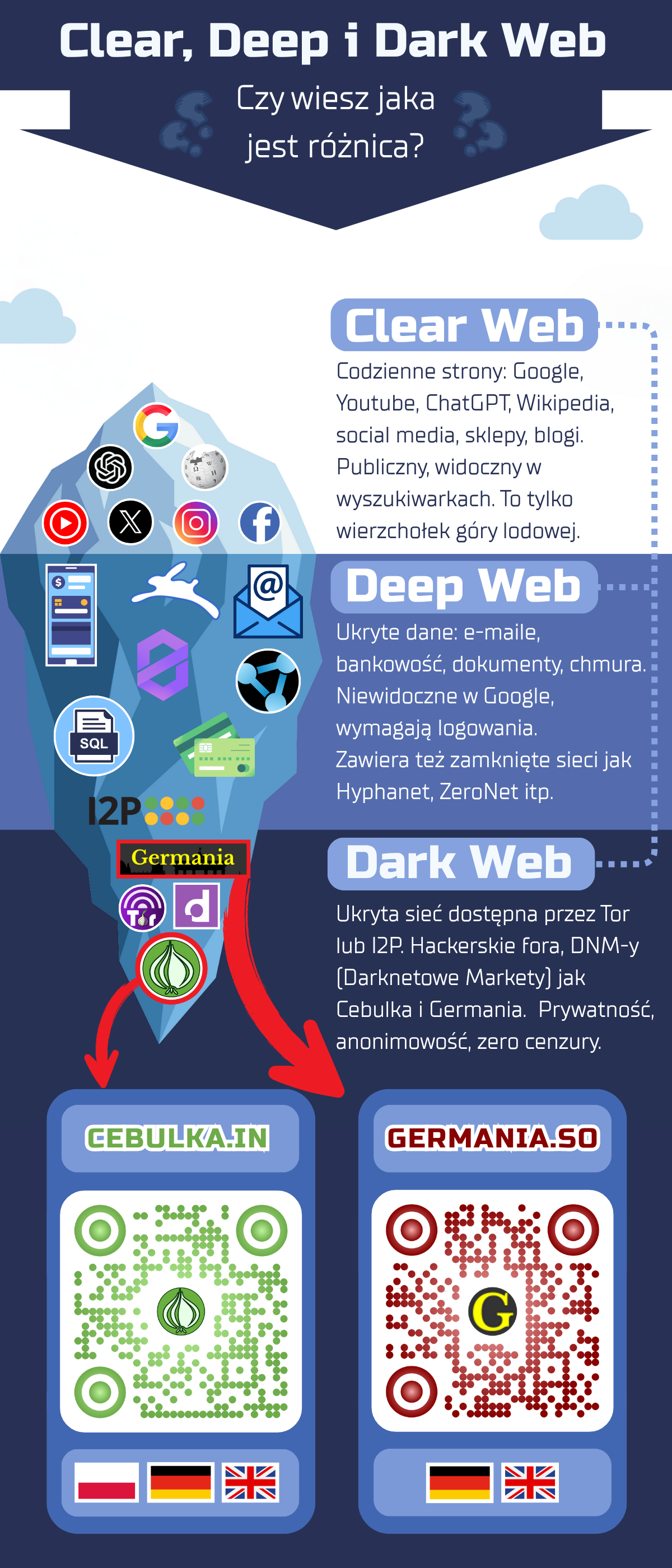
The Deep Web Iceberg Analogy
The internet is often visualized as an iceberg:
- Surface Web (Tip): Everything indexed by search engines—only ~5% of the internet. Websites you find through Google.
- Deep Web (Underwater): The massive 90%+ that's not indexed. Your email, bank accounts, private databases. Accessed with regular browsers.
- Dark Web (Deep Trenches): A tiny portion of the deep web—encrypted networks requiring Tor. Deep web onion sites and hidden services.
Common Misconceptions Debunked
"Deep Web = Illegal"
FALSE. The deep web is overwhelmingly legal and mundane. Your online banking is deep web. Your email is deep web. Private Facebook posts are deep web. There's nothing inherently suspicious about unindexed content.
"Dark Web = All Criminal Activity"
FALSE. While illegal marketplaces exist, the dark web serves many legitimate purposes:
- Journalists protecting sources in authoritarian countries
- Activists organizing in repressive regimes
- Privacy-conscious individuals avoiding surveillance
- Researchers and security professionals
- Major news organizations and NGOs
"You Need Technical Skills to Access Dark Web"
FALSE. Downloading and using Tor Browser is as simple as installing Chrome or Firefox. Finding sites is harder—which is why directories like DARKNET.ZIP exist.
How to Access Deep Web Onion Sites Safely
If you want to explore deep web onion sites (technically dark web sites), follow these steps:
- Download Tor Browser—only from torproject.org
- Consider a VPN—adds extra privacy layer
- Set Security Level—use "Safest" setting
- Find Verified Links—use trusted directories like DARKNET.ZIP
- Never Share Personal Info—maintain strict anonymity
- Stay Legal—accessing the dark web is legal; illegal activities are not
Explore Verified Deep Web Onion Sites
Visit DARKNET.ZIP to access our comprehensive directory of verified onion links and dark web sites.
Browse Directory →Conclusion
The deep web vs dark web distinction is simple once understood: the deep web is everything not indexed by search engines (most of the internet), while the dark web is the small, anonymized portion requiring Tor access.
Neither is inherently good or bad—they're simply different parts of the internet with different purposes. Understanding these differences helps you navigate the digital world more intelligently and safely.
More Resources
Return to Directory • Read More Guides • Dark Web Security Guide